Lahaina Wildfire
Debris Transfer Advisory
back to housing

Rental or Interim Housing

Updated December 2025

FEMA’s Direct Temporary Housing Assistance and financial assistance is currently approved until February 10, 2026

The State of Hawaii requested an extension for the Individuals and Households Program (IHP) for an additional 12 months. The request is currently under FEMA Headquarters and Department of Homeland Security review. FEMA will notify all participating households as soon as the determination becomes available.

  • Direct Housing occupants with questions or concerns are encouraged to contact their FEMA Recertification Advisor for assistance.
    • Occupants in FEMA temporary housing units must continue working towards their permanent housing solution to maintain eligibility for FEMA housing.
    • Recertification Advisors can discuss a permanent housing plan and refer those facing barriers to other housing partners for assistance. Recertification Advisors offer support but are unable to provide permanent housing, directly.

FEMA Direct Lease Program

If you are a survivor of the 2023 Maui wildfires, and you are in FEMA’s Direct Housing Program, the following information may help guide you through the rental payment process.

view FEMA’s Process FAQs (PDF)


What to Expect During the Direct Lease Relocation Process

Learn more

Kāko‘o Maui Housing Program

Kako‘o Maui matches wildfire survivors with the right housing opportunities. These include Short- and Long-term Lease Programs, Host Housing Support Program, DHHL Wildfire Relief Program, and more.

Apply here

Updated December 4, 2025

Key Messages

  • The rebuilding effort on Maui has reached a significant milestone of 100 completed structures, both residential and non-residential.
  • EMA placed all 40 temporary housing units across three secondary sites in Lahaina. This effort supports moving wildfire survivors back to West Maui. Eligible survivors in FEMA’s Direct Housing Program have begun to move-in to their assigned units on the microsites.
    • The first microsite completed all 9 move-ins. The second microsite is comprised of 12 units in total and move-ins have been completed. A third site provides 19 units and move-ins are close to complete.

Housing

  • As wildfire survivors continue to work towards rebuilding, there are currently 529 permits that have been issued, 100 completed and 350 permits that are being processed. Approximately 295 homes are currently under construction. Permits are processed by 4LEAF, a Maui County contractor.
    • To contact 4LEAF, survivors may visit in-person at the County of Maui Service Center at 110 Alaihi St., Suite 207, Monday to Friday 8 a.m. to 4 p.m. or may call 808-270-5724.
  • FEMA encourages survivors hiring a contractor to beware of fraud. Survivors should question contractors and remain vigilant to ensure they are engaging with legitimate contractors. When hiring a contractor, individuals should use the Better Business Bureau, www.bbb.org; verify insurance, licensing and permits; and avoid large up-front payments.
    • Survivors are also encouraged to check the Department of Commerce and Consumer Affairs website (https://cca.hawaii.gov/businesscheck/) to verify license status of potential contractors and to review any previous complaint history.
  • The County of Maui Office of Recovery encourages residents to find official information on Hoʻokumu Hou housing programs directly through the County due to potential fraud by third-party entities. Residents are encouraged to visit hookumuhou.mauicounty.gov or visit the resource centers in Kahului and Lahaina to speak with program specialists.
  • FEMA’s goal is to support wildfire survivors on their path to permanent housing, while helping the Maui community navigate the road to recovery. FEMA’s programs provide temporary assistance designed to help households during their most critical time of need until they secure permanent housing.

FEMA Direct Housing

  • Survivors in FEMA’s Direct Housing program are assigned a Recertification Advisor. Staying in regular contact with their advisor is crucial to remain eligible for temporary housing.
    • Recertification Advisors can discuss a permanent housing plan and refer those facing barriers to other housing partners for assistance. Recertification Advisors offer support but are unable to directly provide permanent housing.
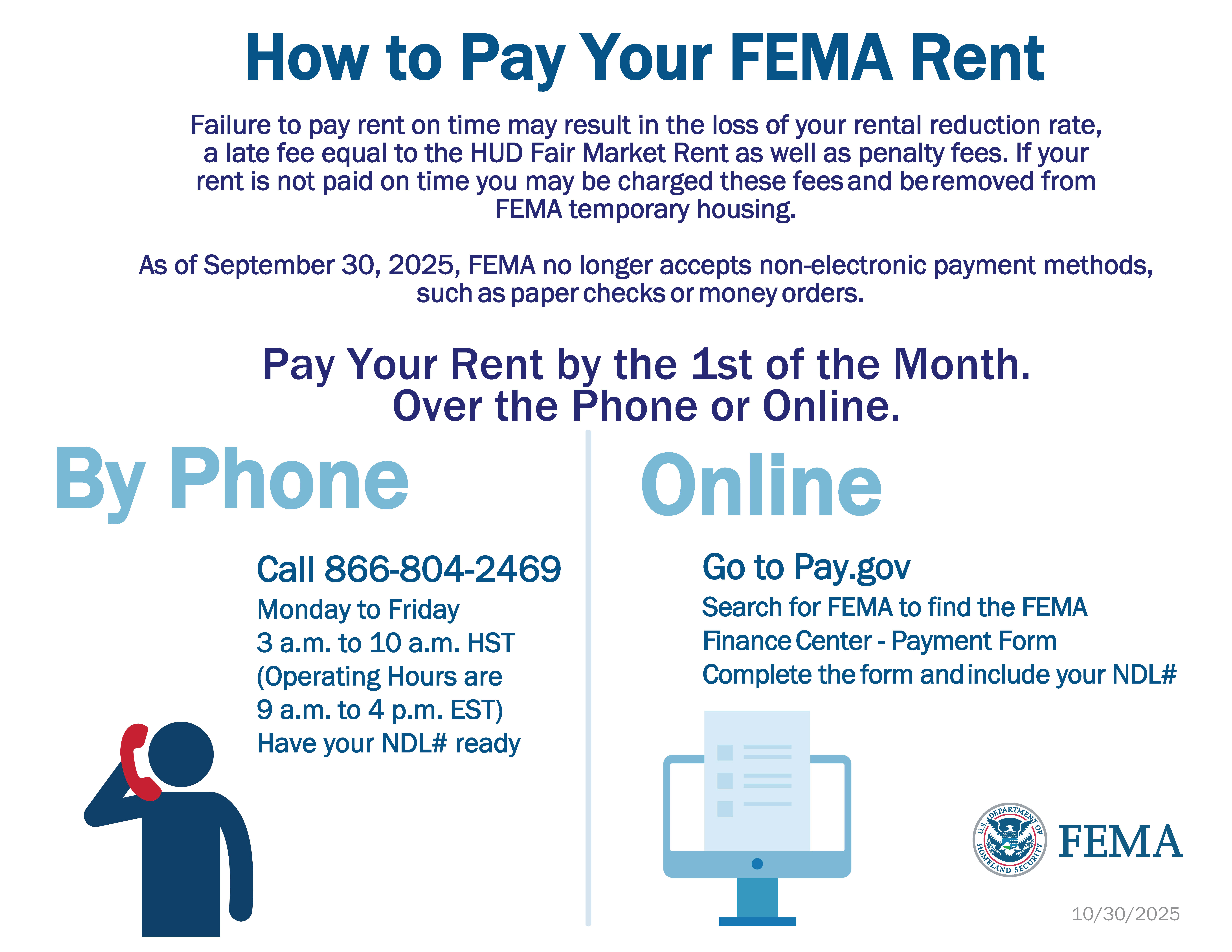
  • As of September 30, 2025, FEMA no longer accepts non-electronic payment methods, such as paper checks or money orders. This change aligns with the Executive Order “Modernizing Payments To and From America’s Bank Account” and supports efforts to improve security, reduce costs and increase efficiency. For detailed payment instructions, please refer to the “How to Pay FEMA” page on FEMA.gov: https://www.fema.gov/about/payment
  • All FEMA Direct Housing participants must pay their full rental amount within 30 days from the first of every month. Payments made after the 30 days from the first of every month will be considered late and will be subject to a late fee equal to the HUD Fair Market Rent of the unit they are occupying as well as associated penalty fees related to the monthly cost for the unit, i.e., Property Management Company fees, Performance Maintenance Inspection fees, furnishing fees and utilities.
    • FEMA offers several convenient options for rent payments:
      • Online: The fastest and most secure method. Log in at www.fema.gov/payments to pay instantly.
      • By Phone: Call FEMA Finance at 866-804-2469, Monday to Friday, from 9 a.m. to 4 p.m. EST (3 a.m. to 10 a.m. HST), for assistance or to make a payment over the phone.

Kilohana Temporary Group Housing Site

  • FEMA continues to house wildfire survivors in 167 units at Kilohana.
  • If residents at Kilohana notice or experience illegal or threatening activity they should call 911 immediately for emergency support. To report speeding, loud noise or other non-emergency activities, residents should call the MPD non-emergency number at 808-244-6400.
  • After disasters, scammers may target survivors. Survivors are encouraged to stay alert and report suspicious activity. They should beware of unexpected calls or visits from individuals saying they work for FEMA. Genuine FEMA representatives will have a laminated badge and the survivors nine-digit FEMA registration number.
  • A bulletin board has been placed at Kilohana that has information on how to pay rent, mental health resources, and local activities and events.
    • Community services are now available for Kilohana residents.
    • Holoholo Bookmobile: Kilohana has been added to the route, offering mobile library services where residents can get a library card, borrow books, DVDs, CDs, and magazines, return items, and pick up pre-requested materials.
      • Every 1st Wednesday, 2:30 p.m. – 3:00 p.m.
    • Da Mobile Market: Provides free produce, meat, and other food items, along with SNAP and MED-Quest application assistance from Project Vision.
      • Every 1st Wednesday, 4:30 p.m. – 5:30 p.m.

FEMA Secondary Sites

  • The first microsite has completed all 9 move-ins. The second microsite is comprised of 12 units in total and move-ins have been completed. A third site provides 19 units and move-ins are close to complete.

FEMA Rental Assistance

  • Survivors who locate temporary housing on their own may get help from the Rental Assistance Program.
  • Survivors who received initial Rental Assistance from FEMA may be eligible for continued rental assistance depending on their need. To request an application for Continued Temporary Housing Assistance or to get help completing the form, call the FEMA Helpline at 800-621-3362. Operators that speak many languages are available from 7 a.m. to 10 p.m. HST, seven days a week. Hours may be longer during high disaster activity. For language services press 2 for Spanish and 3 for other languages.


Keep in Touch with FEMA:

  • Survivors are encouraged to keep their information current because missing or wrong information could delay the delivery of FEMA assistance. When contacting FEMA, survivors should be prepared to give the specialist the nine-digit number assigned to them when they applied for disaster assistance.
  • Visit DisasterAssistance.gov Click on the green ‘Check Status’ button to create an online account. Use the same email provided when applying for assistance. If the survivor applied for assistance online or using the FEMA app, they already have a disaster assistance account.
  • Call the FEMA Helpline at 800-621-3362. If the survivor uses a video relay service, captioned telephone service or other communication services, they should remember to give FEMA their specific number assigned for that service. Helpline operators speak many languages and lines are open from 7 a.m. to 10 p.m. HST, seven days a week. Press 2 for Spanish. Press 3 for an interpreter who speaks another language.

Disaster Case Management:

State Disaster Case Management

  • The State’s Disaster Case Management Program helps assess and address needs through a disaster recovery plan which includes resources, decision making priorities, and providing guidance to help survivors navigate their recovery.

  • State Disaster Case Management services are available at no cost to Maui wildfire survivors. Any survivor who was affected by the wildfires, regardless of FEMA eligibility or other federal assistance, may request help from specially trained disaster case managers. They will help assist to develop a unique and comprehensive recovery plan.

  • To access the State DCMP, call 211 and press '4' to get started and enroll today. DCMP enrollment from the mainland, call 808-ASK-2000 or email DR4724Maui@svdpdisaster.org.

Long Term Recovery Group Disaster Case Management

  • In partnership with local organizations, the Hoʻōla iā Mauiakama Disaster Long Term Recovery Group (Hoʻōla LTRG) has launched a community-led Disaster Case Management and Survivor Support program. Rooted in culturally grounded approaches and values, this program offers a local alternative with trauma-informed, holistic support.

  • To access the LTRG DCMP, call 260-271-9501 or apply online at www.mauilongtermrecovery.org/resources

Mental Health Resources:

  • FEMA continues to support the overall wellbeing of wildfire survivors. The agency’s work with partners at the state, county and community level has increased the availability of comprehensive resources throughout the response and recovery process. FEMA will continue to refer individuals to appropriate resources to support those encountering difficulties that are outside the scope of the agency.
    • To find a comprehensive list of resources to suit specific needs, survivors should visit MauiRecovers.org or call 988 to receive referrals over the phone. Survivors may also contact their Recertification Advisor and their Disaster Case Manager to receive lists of resources available in their area.
    • If survivors have a number with an area code outside of Hawaiʻi and wish to be connected with a local crisis counselor, use the direct number 808-832-3100.
  • Mental health services for adolescent and young children are available through:
    • The Department of Health Maui Family Guidance Center (Child & Adolescent Mental Health Division) is available for youth with severe emotional and/or behavioral challenges. Call 808-243-1252 to inquire about services.
    • Na Keiki O Emalia offers peer-to-peer grief support for children and their families. Call 808-244-7467 for further information.
  • The Lahaina Community Health Center’s Kokua Maui line provides emotional support and resource guidance to survivors of the Lahaina and Kula wildfires. For support, call 808-658-9769, Monday to Friday from 8:30 a.m. to 4 p.m.
  • The Substance Abuse and Mental Health Services Administration’s (SAMHSA) Disaster Distress Helpline offers 24/7 crisis counseling for emotional distress related to a disaster at 800-985-5990.
  • Women Helping Women is available to support women experiencing domestic violence. Their hotline is available 24/7 at 808-579-9581.

State Interim Housing Program:

  • The Hawaiʻi Interim Housing Program (HIHP) is a temporary government program; one of many set-up by entities to include governmental, private, and non-profit; to assist those affected by the August 2023 wildfires. This State program received 2085 applications. There are 610 projected housing units of varying sizes in the program located at Hale o Laie (formerly the Haggai Institute in Kihei) and Ka Lai Ola (in West Maui.) The HIHP application period closed on January 15, 2025. For further information call 808-727-1550 or visit the HIHP website at https://hiorr.hawaii.gov/hihp/.

State Benefits for Low-Income Families

  • Maui Relief TANF (Temporary Assistance for Needy Families) Program, managed by the State of Hawaiʻi Department of Human Services and Maui Economic Opportunity, offers cash assistance to families affected by the wildfires. Eligible families must have at least one dependent child up to age 24 and must have experienced property loss or damage or a reduction of earnings or employment as a direct result of the fires. In partnership with Global Empowerment Mission, the Maui Relief TANF Program offers both short-term (4 months) and long-term (4 months + deposit) rental assistance. To apply, call 808-243-4404; email NRST@meoinc.org or visit www.meoinc.org.

U.S. Small Business Administration:

  • SBA will accept late applications if delays were caused by circumstances beyond the applicant’s control.
    • For assistance with late applications, contact the SBA Customer Service Center at 800-659-2955 or visit http://www.sba.gov/disaster or email disastercustomerservice@sba.gov.
    • For people who are deaf, hard-of-hearing or have a speech disability, dial 7-1-1 to access telecommunications relay services.

For more information

Past rental programs

State of Hawai’i Interim Housing Program (HIHP)

The Hawai‘i Interim Housing Program (HIHP) is no longer accepting new applications as of December 15, 2024, and open applications needed to be submitted by January 15, 2025.  Applicants who can demonstrate they were unable to meet the application closure date due to circumstances beyond their control may request to submit a late application. Late applications can be requested through March 17, 2025 by calling the HIHP Contact Center at 808-727-1550.

Please note that those who applied for HIHP prior to the closure of applications are not guaranteed placement in a unit. Please refer to the program’s website for more information.

The Hawai‘i Interim Housing Program (HIHP) assists those displaced by the Maui wildfires by placing survivor households in temporary state-sponsored housing.  

HIHP is administered by the Hawai‘i Office of Recovery and Resiliency (HORR) in collaboration with the State of Hawai’i’s Department of Human Services (DHS) and Hawai’i Housing Finance and Development Corporation (HHFDC).  

HIHP includes all State of Hawai‘i interim housing sites related to Maui wildfire recovery, including Hale ‘O Lā‛ie, formerly the Haggai Institute in Kihei, and Ka La’i Ola in West Maui, north of Lahaina.  

Eligibility Requirements

You may be eligible for HIHP if:  

  • You resided in Maui County prior to the disaster.  
  • You are displaced from your permanent residence due to the Maui Wildfires, or  
  • You faced disaster-related unemployment that resulted in the loss of your home.

If you are not sure if you are eligible for HIHP, you are still encouraged to apply.

These are two designs of prefabricated homes that the state Department of Human Services will be using for its temporary group housing in Lahaina. (Courtesy: Department of Human Services)

State of Hawai’i Interim Housing Program (HIHP)

Kā La‘i Ola

Kā La‘i Ola temporary housing project features 450 furnished, prefabricated homes and 26 community buildings on state land in Lahaina designated for residential development.

The deadline to apply for the Hawai‘i Interim Housing Program (HIHP) has passed. Applicants who can demonstrate they were unable to meet the application closure date due to circumstances beyond their control may request to submit a late application. Late applications can be requested through March 17, 2025 by calling the HIHP Contact Center at 808-727-1550.

State of Hawai‘i Interim Housing Program (HIHP)

Hale o La‘ie

The Hale o La‘ie project, located at 175 E Lipoa Street in Kihei, features 175 furnished guestrooms, various amenities, and a convenient location in a mixed-use neighborhood. The facility will initially be operated as temporary housing for certain individuals and families displaced by last year’s wildfires.

The deadline to apply for the Hawai‘i Interim Housing Program (HIHP) has passed. Applicants who can demonstrate they were unable to meet the application closure date due to circumstances beyond their control may request to submit a late application. Late applications can be requested through March 17, 2025 by calling the HIHP Contact Center at 808-727-1550.

FAQs for State of Hawai’i Interim Housing Program (HIHP)

What documentation do I need to provide?

Applicants to HIHP may be asked to provide the following documentation:  

  • Proof of identity. This documentation does NOT have to indicate citizenship status.
  • Proof of pre-disaster residency within Maui County.
  • Proof of income loss and inability to pay rent or mortgage.
  • Documentation of any other assistance you may have received related to the Maui Fires.

I have already received assistance related to the Maui Wildfires. Can I still apply?

Households who received other assistance may still be eligible for HIHP and are encouraged to apply.

I was unhoused before the wildfires, am I eligible for HIHP?

This program is for those displaced from their homes by the Maui Wildfires. Those experiencing homelessness can visit homelessness.hawaii.gov/help to get help.

Who is included in my household?

We recognize that your household members may have changed following the wildfires. Your application should include all individuals you plan to live with if you are placed in an interim housing unit.

Are there income, demographic, or citizenship requirements for this program?

Eligibility for HIHP is not assessed based on income, demographic makeup, or citizenship of household members.

Will I be paid directly from this program?

No, HIHP does not make direct payments to survivor households.

If I am found eligible for HIHP, am I guaranteed a housing unit?

Eligibility does not guarantee placement in an interim housing unit. Eligible applicants will be matched with interim housing units based on availability.

What will the program do with the personal information I provide?

The information you provide will be utilized to evaluate your needs and eligibility. Your household data will not be sold. Applicant information may be shared with State and Federal agencies, their contractors, nonprofit organizations, and other partner agencies for the purpose of providing assistance related to the 2023 Maui Wildfire Disaster. 

Will the program ask me for money?

Applying to HIHP is completely free. Applicants placed in an interim housing unit will not be asked to contribute to rent or utility payments through August 2025.

Will I be required to sign up for the Disaster Case Management Program?

Yes. Applicants to HIHP are required to sign up for the Disaster Case Management Program (DCMP). DCMP is a FEMA-funded effort that allows trained case managers to collaborate with disaster survivors to develop a disaster recovery plan and to work together to address the unmet needs described in the plan. Applicants who have applied to DCMP but have not yet been assigned a case manager will still be eligible for HIHP.

How long can I remain in the interim housing provided to me?

The length of your stay in an interim housing unit depends on several factors and will be assessed on an ongoing basis.

Can I bring my pet(s)?

Interim housing sites may be able to accommodate pets. Please describe your pets in the application so that a HIHP team member can match you to the interim housing unit that best meets your needs.

How do I sign up for the Disaster Case Management Program (DCMP)?

Survivors should contact 211 to begin the process and request follow up from a DCMP team member to conduct an intake discussion.

Is application assistance available?

Households who need help applying to HIHP, including those with limited English proficiency, can contact the Call Center at 1-808-727-1550 for assistance.  

How do I apply?

You can apply by visiting this page or calling 1-808-727-1550 and completing the questions for your household. You will be required to register an account online with a valid email address to receive program updates and to provide required documentation. If you do not have an email address, you may call our contact center at 1-808-727-1550 for them to help create one for you.  

If you have previously applied for assistance with FEMA or American Red Cross, some of your information may already be pre-populated in the application. Please review all information and complete any missing fields. When your application is complete, a member of the HIHP team will contact you to discuss the next steps.  

Am I eligible for HIHP?

You may be eligible for HIHP if:

  • You lived in Maui County prior to the disaster.  
  • You are displaced from your residence due to the Maui Wildfires, or…
  • You faced disaster-related unemployment that resulted in the loss of your home.
What is HIHP (Hawaiʻi Interim Housing Program)?

The Hawai‘i Interim Housing Program (HIHP) assists those displaced by the Maui wildfires by placing survivor households in temporary state-sponsored housing. The program is administered by the Hawai‘i Office of Recovery and Resiliency (HORR) in collaboration with the State of Hawai‘i’s Department of Human Services (DHS) and Hawai‘i Housing Finance and Development Corporation (HHFDC).  HIHP includes all State of Hawai‘i interim housing sites related to DR-4724-HI Maui Wildfires recovery, including Hale ‘O Lā‛ie, formerly the Haggai Institute in Kīhei, and Ka La‘i Ola in West Maui.

What are my housing options if I am approved?

HIHP has two housing sites, Hale ‘O Lā‘ie, formerly the Haggai Institute, in Kihei, and Ka La‘i Ola in West Maui.  More housing sites may be added to HIHP in the future. If approved for placement, a HIHP team member will work with you to match your household to an available housing solution that best meets your needs as units become available. The timeline for placement is dependent on unit availability.  

Do I need to pass a background check to be eligible?

Yes, everyone in your household 18 and older must complete a background check to qualify for HIHP. Background check results will be assessed on an individual and household basis. 

Are there housing units available for those with special needs?

Many interim housing units can accommodate access and functional needs. Please describe your household’s specific requirements in your application so a HIHP team member can find the housing solution that best meets your needs.  

Get Support